Saturday, January 15, 2011

On Cooking With Your Dead Grandmother


Within minutes, Rosa had two pans going. One contained roundels of already-cooked potato stolen from the next day’s roast, which were stewing slowly in olive oil. The other was sizzling sliced onions, on a much higher heat. She beat half a dozen eggs and slid the bowl to one side. She’d have tortilla in fifteen minutes.
More onions, finely chopped this time, went into a big pan and as soon as they were soft she covered them with ladlefuls of Doris’s chicken stock. As she started to portion the chickens, she paused. Something else was needed here. She pictured her grandmother Mercedes in their kitchen back home and spoke out loud:
‘Abuelita. I’m stuck in this terrible English kitchen with no chorizo, no tocino, no judias blancas, no garbanzos, no… garbanzos… garbanzos…’ She’d seen a few tins of chick-peas somewhere that Gladys occasionally used to make her own hummus.. ‘OK, that’s one. I need more ideas. Come on Abuelita. Help me!’
‘Stop thinking about what you want, girl. See what you’ve got. And then use that.’
Rosa rushed into the walk-in fridge and lunged around, looking for ingredients and inspiration at the same time. Nothing resonated with her culinary experience, until she landed on the trays of tourist fare. Of course. She grabbed some plaice fillets and two slices of the gammon bacon. Back at the chopping board, she skinned the fishes, trimmed and diced the bacon. She’d make them as sweet as merluza and chorizo. She even remembered to throw the pieces of bacon-rind into her stew.
By the time Doris returned, Rosa was flying, although she was still talking to herself intermittently. Doris found this disconcerting, until it was explained to her, whereupon she offered to stand in for Mercedes, for the sake of both their sanities. She put her pinnie on and offered to help.
Rosa piled garlic into the simmering stew-pot and thrust a couple of red peppers on to an open flame to burn off the skins. In went the saffron, bay leaves and paprika, and finally the chicken portions. Lid on, she left it to simmer away gently.
The stewed potatoes and brown onions were amalgamated in one pan and on went the eggs, to bubble and colour. As soon as the egg mixture pulled away from the sides of the pan, she rammed it under the grill to brown the top, and then turned it over on to a plate. Doris sliced it up and out went the first dish with a basket of crusty bread.
Rosa flash-fried the pieces of plaice and bacon with fresh red chilli and garlic. Placing them on some lettuce leaves, she dressed them with olive oil and lemon and a sprinkling of parsley, while Doris set about heating up the chick-peas.
“What are we doing with these?”
“Warm salad. Erm… fresh tomatoes, chopped, garlic, parsley and spring onion, French-style dressing with mustard… There’s still something missing… I know…”
She opened a jar of German Bockwurst, split the chubby sausages in two lengthways, and made a few slashes across the tops. Into one of the vacant frying pans and they were done in a few minutes. Village sausage, she called it, topping off the chick-pea salad. Out went the next two dishes. Rosa cleaned up her peppers and put them in the stew with the spinach and pine-nuts. Doris took the whole pot out and placed it centre-table with a ladle, before they’d even started on the middle course.

Friday, January 14, 2011

Glenn Haybittle - Letter To My Editor

Check out Glenn Haybittle's "Letter To My Editor" post at Errands Into The Maze Yes, that's me he's talking to. No, we don't have a difference of opinion. It's always interesting when you can provoke a clear statement of intent, which this certainly is.

Tuesday, January 11, 2011

Review Comment - The Alchemy of Chance

The Alchemy of Chance is a foodie’s dream. I loved the descriptions of the meals and wanted the food right out of Antoinette's kitchen - soft eggs in cream, simply grilled fillet of sole with lemon, and roast leg of lamb - so I cooked everything in the book, using local, seasonal ingredients, just as Peter's characters did. Fabulous. A great read.

Janet Beck, Victoria, B.C. Canada

Tuesday, January 4, 2011

Reading Glenn Haybittle's - That Time Is Past


I'm reading Glenn Haybittle's revisons of That Time is Past. Ivan, who has abandoned his wife and children to write a biography of Shelley and live in Italy with the appropriate Romantic intensity, is taking the beautiful, if distant, Isabella on a tour through the Villa Cenci, the centre of a lurid family tragedy involving incest and murder in 16th century Rome, that inspired Shelley to write a verse drama. Instead of imaginatively entering the passion and atmosphere of the place in search of what Shelley saw or thought, he's analysing his non-relationship with Isabella.

"He thought of something Shelley had written in relation to Epipsychidion: “I think one is always in love with something or the other; the error, and I confess it is not easy for spirits cased in flesh and blood to avoid it, consists in seeking in a mortal image the likeness of what is eternal.”

The quote holds a core truth of the novel. Almost everyone in the book is avoiding anything like a meaninful relationship while busy imposing some ideal of their own on someone else, and finding they fall short, and the revisions are strengthening that point.

The Romantics touted strong emotion as the 'real' source of aesthetic experience, but these neo Romantics, who, as Lady Lydia points out, seem to be "at rather a loss," make a career out of completely avoiding anything that smacks of actual emotional involvement. There is much here on the modern engagement/disengagement question but it's well coated with wit and fun and a good helping of Italian light.

Sunday, January 2, 2011

Review - The Alchemy of Chance


“I don’t read much Francophile literature - soft-focused Frenchness makes me mutter - but Peter Brooks writes a France that I recognize. His Paris is noisily Parisian. His Brittany is blown through with sharp, salty air and the smells of seafood. His Loire is all liquid light and the still, strange atmosphere of that river.... 'Alchemy' is full of light, life and heart. There’s also a small sprinkling of magic in there. It's one of those novels that leave me smiling at the world a little more.

Caroline Scott, Lot, France

Image - Detail of "Carlotta on the Loire" by Sir William Russell Flint

Wednesday, December 29, 2010

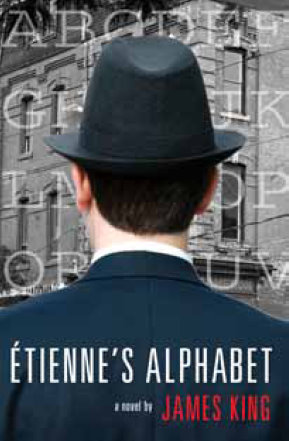
Review - Etienne's Alphabet by James King


The phrase “two solitudes,” referring to the perceived lack of communication between English and French speakers in Canada, and also to the lack of interest in redressing the situation, is well known in Canadian political discourse. The term was popularised by Hugh MacLennan’s novel Two Solitudes, but probably originated in a 1904 letter written by Rilke to a friend, about the changing nature of love between men and women, love born out of their individual solitudes. “This advance ... will transform the love experience, which is now filled with error, will change it from the ground up, and reshape it into a relationship that is meant to be between one human being and another... And this more human love... will resemble what we are now preparing painfully and with great struggle: the love that consists in this: the two solitudes protect and border and greet each other.”

Rilke’s optimistic view seldom crosses over to the political use of the term, but in Etienne’s Alphabet, by James King, both meanings come into play.

Etienne is half Anglo, half Francophone, and a complicated character. He objects with good reason, to the labels his doctor’s pin on him – OCD and schizoid – as the truth is much less tidy. He makes lists of the physical characteristics of the people he meets and would otherwise fail to recognise them, suggesting he suffers from face blindness. Letters speak to him, have colours and personalities– c and s are arrogant, d has humility, e attracts the colour green, F is the Hamlet of the alphabet, very indecisive, G is a fretful letter, h is a wallflower, I the letter of loneliness - words form pictures of their meaning, he can see smells, all of which suggests a complex synaesthesia at work. He has no interpersonal skills, makes no emotional connections to other people. Another character points out “you understand numbers but have not the slightest idea about people.” He is reticent, detached, brash, melancholic. He talks like a robot and never fits in with his confreres. He seems to be a high functioning autistic and is the embodiment of the two solitudes. Etienne’s Alphabet is his story, told through a series of dictionary entries that make his identification with the schism in the Canadian identity plain, at the same time as they reveal something of his extraordinary view of the world around him.

In an entry on Kaspar Hauser Etienne says “I am a riddle to myself. I have never been subjected to the inhumane regime inflicted upon Hauser. But like him, I do not know how I became the person I am. What is the mystery ailment in my soul that keeps me so desperately apart from others? His notes on Jean-Paul Riopelle point out that the artist wrote to Premier Duplessis in 1948”telling him that both Canada and Quebec were too isolated from the rest of the world. ‘You must open up,’ he had demanded. Of course, his plea was ignored.” The advice Riopelle gives Duplessis is the same advice Etienne’s colleagues and superiors at the bank give him, and it has the same result.

Etienne seldom speaks directly about his feelings, except when he finds himself in a rant about English Canada’s prejudices against French Canadians, We are left to infer, to piece together his life from what he chooses to tell us about what he chooses to talk about.

Aardvark: Charming looking little creatures with built-in suits of armour...

Alphabet: Letters obviously hold the entire world together. Otherwise, there is no order, no language, no significance...

Appearances: They are not really deceiving...

Weasel: Weasels are synonymous with deceit, trickery and false promises. When I began my drawings ten years ago, I promised myself no portraits of any kind because the genre is subject to those awful vices.... People are vainglorious, unduly complicated and, ultimately, beyond understanding. Why should I subject myself to such a dubious enterprise as putting them on paper?

Zigag: Life is a series of abrupt right and left turns. There is no clear path, as Dante informs us...

After his death, Etienne’s landlady, who has taken care of him all his adult life, finds boxes of brightly coloured drawings in his rooms, a remarkable body of work as refractive, brilliant, suggestive and teasing as his autobiographical notes.

The oddly chosen entries in his idiosyncratic dictionary reveal a fascinating mind grappling with an often incomprehensible world, and eventually imposing, as all artists do, some sort of order on it. His story is carefully, hopefully, tenderly presented. An opaque character grows translucent, we begin to understand a little of what makes someone very unlike ourselves tick, and by the time Zodiac – a complete circuit, the compass of eternity – comes round we face Etienne in the way Rilke dreamed we would, as two solitudes greeting each other.


Published by Cormorant Books - ISBN 9781897151877 | 5.5" x 8.5" | TPB with French Flaps | $21 Cdn.

You can read a preview or download an exerpt of Etienne's Alphabet at Cormorant Books

Sunday, December 26, 2010

The Alchemy of Chance Recipes - Potato Gratin


There is something wonderfully simple about potatoes. It takes almost nothing to take them from everyday to extraordinary with only basic ingredients. When Didier and Maria started their meal with a potato gratin I could almost imagine the incredible smell that permeated the kitchen. The best part is it comes together so quickly that there is time to relax with that glass of wine Marie was pouring. I make potato gratin often, sometimes in a large dish that is placed on the table for everybody to pass carefully around or when I want something a bit more formal I make individual dishes, which I turn out on the plate. As with everything in Pete's book the recipe is pretty simple and you just adjust amounts to fit the size of the dish you need. I have used ramekins as small as a 3 1/2"creme brulee dish to a 4 1/2" ramekins for individual servings; it all depends on what else is for dinner. The important thing when make small servings is to line the dish with parchment paper on the bottom and the sides. It is a bit of work but it makes the end results much better as the potatoes slide easily from the dish to the plate; I have also lined a large casserole dish for serving 10 to 12 people; I still like to use parchment on the bottom of the dish because the potatoes take on a beautiful golden colour. I have even turned the large dish out on a serving tray and arranged other roasted vegetables around it.

The important thing to remember is that the first row of potatoes will become the top of your dish, if you are turning it out, so take the time to make it look good. I generally place a couple of small sprigs of thyme on the bottom and then start to place the potatoes in concentric circles around the dish overlapping just a bit. The great thing about cooking like this is that you can adjust the dish as you like, sometimes I alternate layers with sauteed mushrooms or with other root vegetables such as turnips, sweet potatoes or parsnips; no matter what else I put in it I always use onions. I tried a recipe in a magazine recently where you alternated layers of potatoes with oven dried yellow and red tomatoes;it was delicious and gorgeous on the plate.

Potato Gratin

2 cups whipping cream
3 pounds potatoes, Yukon Gold work well but you can use any good potato. Try to get them roughly the same size.
1 small onion
1 1/2 teaspoons salt
1 teaspoon black pepper
1 1/2 teaspoons dried thyme
enough soft butter to coat the dish

Thinly slice potatoes and onion using either a mandolin or a good sharp knife. If you are making individual servings line the bottom and sides of your dish with parchment paper and butter the paper; or, alternatively, butter the bottom and sides of a 9" x 13" casserole dish. Arrange three layers of potatoes around the bottom of the dish, overlapping each potato slightly then add a small layer of onion. Top the third layer with onions and some of the salt, pepper and thyme. Continue layering potatoes and onion, sprinkling the onion layer with salt, pepper and thyme until complete.

Place dish on a cookie sheet, to catch any of the liquid that may boil over. Gently add the cream, pushing down on the potatoes to almost cover them. Bake in a preheated 400 degree oven for 30 minutes then reduce temperature to 350 degrees and continue to bake until potatoes are tender. If you are using individual ramekins reduce temperature after 20 minutes and continue to cook until potatoes are tender, about 25 minutes more. The cream will be almost completely absorbed. Let the gratin rest for 15 minutes before serving.

This dish can be made ahead of time and reheated in a 350 degree oven until heated through, making it a great dish for taking to friends or to get a head start for a dinner party. Enjoy
Janet Beck