The phrase “two solitudes,” referring to the perceived lack of communication between English and French speakers in Canada, and also to the lack of interest in redressing the situation, is well known in Canadian political discourse. The term was popularised by Hugh MacLennan’s novel Two Solitudes, but probably originated in a 1904 letter written by Rilke to a friend, about the changing nature of love between men and women, love born out of their individual solitudes. “This advance ... will transform the love experience, which is now filled with error, will change it from the ground up, and reshape it into a relationship that is meant to be between one human being and another... And this more human love... will resemble what we are now preparing painfully and with great struggle: the love that consists in this: the two solitudes protect and border and greet each other.”
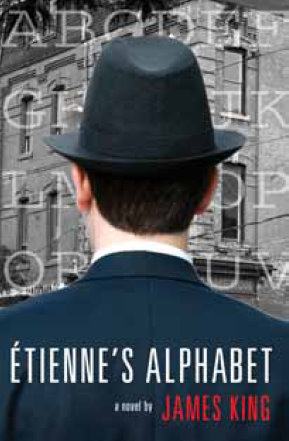
Rilke’s optimistic view seldom crosses over to the political use of the term, but in Etienne’s Alphabet, by James King, both meanings come into play.
Etienne is half Anglo, half Francophone, and a complicated character. He objects with good reason, to the labels his doctor’s pin on him – OCD and schizoid – as the truth is much less tidy. He makes lists of the physical characteristics of the people he meets and would otherwise fail to recognise them, suggesting he suffers from face blindness. Letters speak to him, have colours and personalities– c and s are arrogant, d has humility, e attracts the colour green, F is the Hamlet of the alphabet, very indecisive, G is a fretful letter, h is a wallflower, I the letter of loneliness - words form pictures of their meaning, he can see smells, all of which suggests a complex synaesthesia at work. He has no interpersonal skills, makes no emotional connections to other people. Another character points out “you understand numbers but have not the slightest idea about people.” He is reticent, detached, brash, melancholic. He talks like a robot and never fits in with his confreres. He seems to be a high functioning autistic and is the embodiment of the two solitudes. Etienne’s Alphabet is his story, told through a series of dictionary entries that make his identification with the schism in the Canadian identity plain, at the same time as they reveal something of his extraordinary view of the world around him.
In an entry on Kaspar Hauser Etienne says “I am a riddle to myself. I have never been subjected to the inhumane regime inflicted upon Hauser. But like him, I do not know how I became the person I am. What is the mystery ailment in my soul that keeps me so desperately apart from others? His notes on Jean-Paul Riopelle point out that the artist wrote to Premier Duplessis in 1948”telling him that both Canada and Quebec were too isolated from the rest of the world. ‘You must open up,’ he had demanded. Of course, his plea was ignored.” The advice Riopelle gives Duplessis is the same advice Etienne’s colleagues and superiors at the bank give him, and it has the same result.
Etienne seldom speaks directly about his feelings, except when he finds himself in a rant about English Canada’s prejudices against French Canadians, We are left to infer, to piece together his life from what he chooses to tell us about what he chooses to talk about.
Aardvark: Charming looking little creatures with built-in suits of armour...
Alphabet: Letters obviously hold the entire world together. Otherwise, there is no order, no language, no significance...
Appearances: They are not really deceiving...
Weasel: Weasels are synonymous with deceit, trickery and false promises. When I began my drawings ten years ago, I promised myself no portraits of any kind because the genre is subject to those awful vices.... People are vainglorious, unduly complicated and, ultimately, beyond understanding. Why should I subject myself to such a dubious enterprise as putting them on paper?
Zigag: Life is a series of abrupt right and left turns. There is no clear path, as Dante informs us...
After his death, Etienne’s landlady, who has taken care of him all his adult life, finds boxes of brightly coloured drawings in his rooms, a remarkable body of work as refractive, brilliant, suggestive and teasing as his autobiographical notes.
The oddly chosen entries in his idiosyncratic dictionary reveal a fascinating mind grappling with an often incomprehensible world, and eventually imposing, as all artists do, some sort of order on it. His story is carefully, hopefully, tenderly presented. An opaque character grows translucent, we begin to understand a little of what makes someone very unlike ourselves tick, and by the time Zodiac – a complete circuit, the compass of eternity – comes round we face Etienne in the way Rilke dreamed we would, as two solitudes greeting each other.
Published by Cormorant Books - ISBN 9781897151877 | 5.5" x 8.5" | TPB with French Flaps | $21 Cdn.
You can read a preview or download an exerpt of Etienne's Alphabet at Cormorant Books


